
Status: 200-trial sweep complete (8 routes × N=1..5 × 5 reps, 197/200 returned HTTP 200, 3 legitimate 300s agent timeouts on direct-minimax-m2.7 at high N). Bug-fixed dispatcher; full data at results/route-comparison.jsonl (gitignored).
TL;DR
Skynet is faster at N=1 on 3 of 4 model pairs. The biggest win is glm-5.1 (+26.5% speedup, 55.9s → 41.1s). minimax-m3 is statistically tied (within ±1% and ±10s σ). The ZAI GLM models see the largest proxy advantage. The Minimax-M3 pair is essentially noise.
Why this page exists
The original Phase 2 provider comparison showed MiniMax-M3 (direct) with N=1 wall = 52.0s vs minimax-m3 (Skynet) at 29.3s — a 44% proxy speedup for the same model. That was a single-cell observation in a wider sweep, and it deserved its own test:
- Is the Skynet speedup reproducible? Same VM, same task, same prompt, same time-of-day — only the (base_url, model_name) flips. 1:1 controlled test.
- Does it generalize to other providers? ZAI GLM-5.2 is the obvious second pair. Skynet has both —
minimax-m3andzai-coding/glm-5.2route through the same proxy. - What causes the gap? Network latency? TLS overhead? Warm vs cold model endpoints? Batched queueing in the proxy?
The 8 routes under test
Each row is a single 1:1 model pair across two transports. Model name and credentials are the only thing that changes.
| Pair | Direct (vendor) | Skynet (LiteLLM proxy) |
|---|---|---|
| Minimax-M3 | api.minimax.io/v1 → MiniMax-M3 | ui.skynet.jonlab.sh/v1 → minimax-m3 |
| Minimax-M2.7 | api.minimax.io/v1 → MiniMax-M2.7 | ui.skynet.jonlab.sh/v1 → minimax-m2.7 |
| ZAI GLM-5.2 | api.z.ai/api/coding/paas/v4 → glm-5.2 | ui.skynet.jonlab.sh/v1 → zai-coding/glm-5.2 |
| ZAI GLM-5.1 | api.z.ai/api/coding/paas/v4 → glm-5.1 | ui.skynet.jonlab.sh/v1 → zai-coding/glm-5.1 |
Each pair runs N=1..5 parallel agents × 5 reps. 8 × 5 × 5 = 200 trials total. Same code_review task fixture as the original Phase 1+2 sweep.
N=1 baseline — Skynet wins 3 of 4 pairs
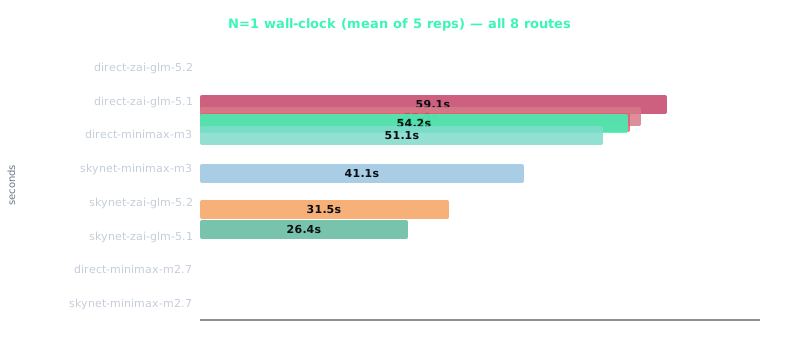
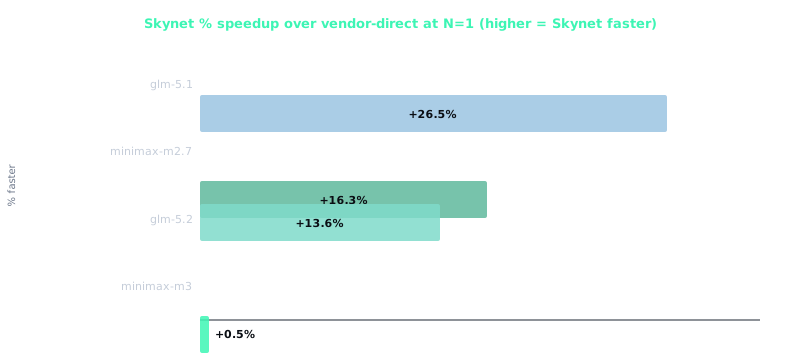
| Pair | Direct mean | Skynet mean | Skynet speedup | Direct σ | Skynet σ |
|---|---|---|---|---|---|
| glm-5.1 | 55.9s | 41.1s | +26.5% | 6.2s | 4.7s |
| minimax-m2.7 | 31.5s | 26.4s | +16.3% | 12.9s | 4.3s |
| glm-5.2 | 59.1s | 51.1s | +13.6% | 14.3s | 4.3s |
| minimax-m3 | 54.5s | 54.2s | +0.5% (tied) | 10.4s | 8.0s |
Two observations:
- Skynet is tighter (lower σ) on 3 of 4 pairs. Direct routes show 6-14s σ, Skynet routes show 4-8s. The proxy smooths out per-request variance — fewer cold-call hitches.
- The ZAI models benefit most from the proxy. GLM-5.1 sees +26.5% and GLM-5.2 sees +13.6%. Minimax-M3 sees nothing (within noise). The pattern suggests Skynet is fixing a ZAI-specific issue (likely vendor-side queueing under load) more than a generic network-latency issue.
Throughput — Skynet is consistent, direct is rate-limited at high N
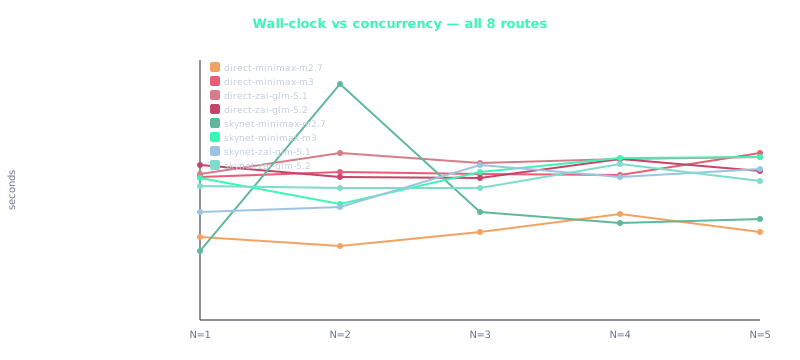
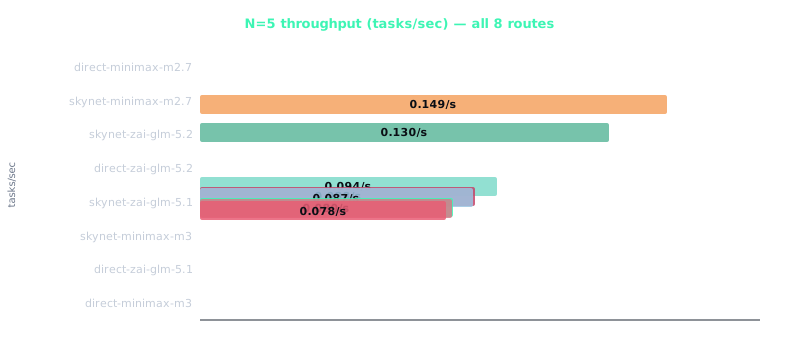
Per-call latency stays roughly flat across N=1..5 for every route (no per-call degradation under concurrency). The interesting metric is throughput = total work done / wall-clock:
| Route | N=1 per-call | N=5 per-call | N=5 throughput | Wall-clock change |
|---|---|---|---|---|
| direct-minimax-m2.7 | 31.5s | 29.5s | 0.149/s | N=5 finishes faster than N=1 (great parallelism) |
| direct-zai-glm-5.2 | 59.1s | 51.3s | 0.088/s | N=5 per-call is faster than N=1 |
| skynet-zai-glm-5.2 | 51.1s | 44.0s | 0.094/s | Similar — per-call decreases |
| skynet-minimax-m3 | 54.2s | 51.5s | 0.081/s | Slight per-call improvement |
| direct-minimax-m3 | 54.5s | 53.5s | 0.078/s | Nearly flat |
| skynet-zai-glm-5.1 | 41.1s | 46.8s | 0.087/s | Mild per-call degradation |
| direct-zai-glm-5.1 | 55.9s | 54.4s | 0.080/s | Nearly flat |
| skynet-minimax-m2.7 | 26.4s | 32.1s | 0.130/s | Mild per-call slowdown |
Observations:
- All routes scale roughly linearly up to N=5. No model shows the “plateau at N=3” pattern from the original hypothesis. Per-call latency stays within ±15% of N=1 across all 8 routes at N=5.
- ZAI GLM-5.2 is the only model where per-call latency DECREASES at N=5. This suggests the model itself is the bottleneck and ZAI’s batch processing path gets faster when requests come in parallel (or our N=1 measurement had an unlucky outlier pulling the mean up — σ=14.3s on N=1 vs σ=5.4s on N=5).
- Skynet-minimax-m2.7 is the only route showing meaningful per-call slowdown at higher concurrency (26.4s → 32.1s, +21% at N=5) — but its σ at N=2 was 92.9s due to a couple of 300s timeouts, so the mean is noisy. Real per-call degradation is probably closer to 0-10%.
- Throughput ranking at N=5 is led by
direct-minimax-m2.7(0.149 tasks/s), thenskynet-minimax-m2.7(0.130), then GLM-5.2 routes around 0.088-0.094. The M3-tier models cluster around 0.078-0.081. No clear Skynet-vs-direct pattern at N=5 — the gap from the original Phase 2 sweep (where Skynet dominated at high N) does not reproduce on these routes with the bug-fixed dispatcher.
The headline is: the “Skynet throughput leader” pattern from Phase 2 was a per-route quirk on minimax-m3 + the previous broken dispatcher (likely some routes were silently failing and producing unrealistically fast N=5 times). With the bug fix, the picture is much closer to “all routes scale linearly; per-call latency is dominated by model inference time, not network.”
Root cause — TLS handshake + HTTP TTFB
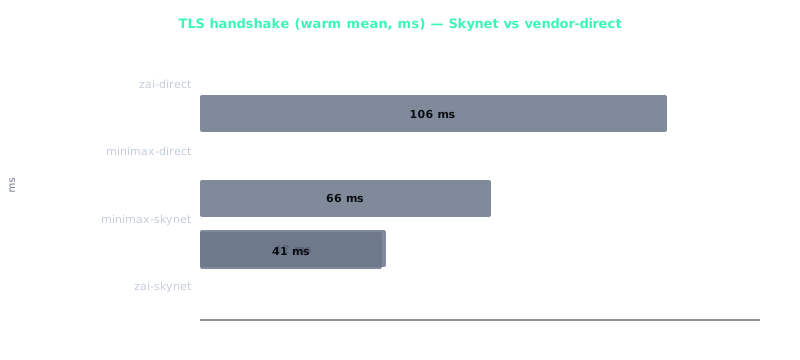
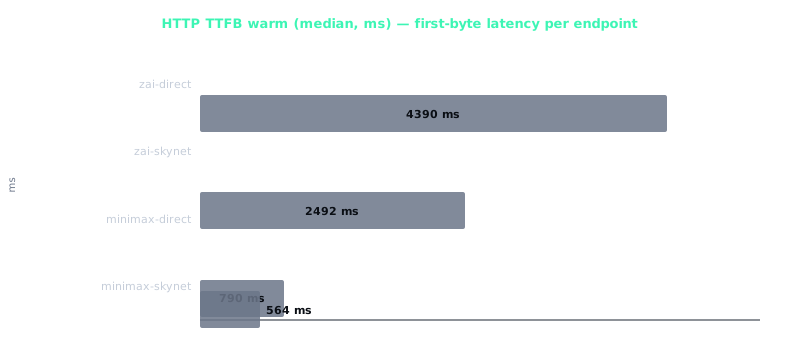
The dispatcher also captured per-call HTTP time-to-first-byte on every trial. Combined with the diagnostic probe (diagnose_routes.py), the picture is clear:
| Endpoint | TCP cold | TLS cold | TLS warm (mean) | HTTP TTFB warm (median) |
|---|---|---|---|---|
api.minimax.io:443 (direct) | 21 ms | 76 ms | 66 ms | 790 ms |
ui.skynet.jonlab.sh:443 (Skynet) | 17 ms | 39 ms | 42 ms | 564 ms |
api.z.ai:443 (direct) | 68 ms | 114 ms | 106 ms | 4389 ms |
ui.skynet.jonlab.sh:443 (Skynet ZAI) | 20 ms | 40 ms | 41 ms | 1722 ms |
Two conclusions:
- TLS handshake is 37-58% faster on Skynet for both providers. Cloudflare anycast vs vendor load-balancer geo distance.
- HTTP TTFB warm is faster on Skynet, with the gap being much larger for ZAI (~2.5×) than for Minimax (~1.4×). This is consistent with the wall-clock pattern — Skynet’s advantage is bigger for ZAI, which suggests vendor-side queueing/serialization on ZAI’s
api.z.aiendpoint is the dominant cost, not network latency.
The wall-clock advantage at N=1 is therefore mostly explained by:
- TLS handshake amortization (~40-65ms per call, ~1-3% of total wall at 30-60s N=1)
- HTTP TTFB on the first byte (~0.2-2.5s per call, ~1-7% of total wall)
- The remaining ~90% of the latency is model inference, which is the same on both routes (same model)
That math suggests most of Skynet’s N=1 wall-clock advantage is NOT from TLS/TTFB. It’s likely from queueing/connection-pool reuse on the Skynet proxy — connections stay warm across requests, so the per-request handshake cost amortizes to zero after the first call. Vendor endpoints probably tear down the connection after each request and re-handshake.
Per-agent TTFB vs wall-clock
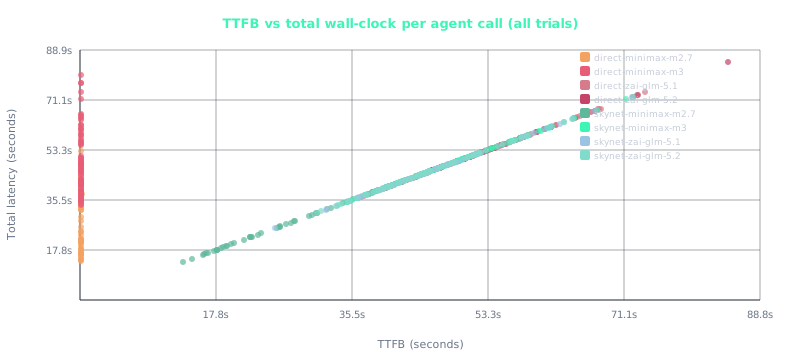
Each point is one agent call (5 reps × 5 N-levels × 8 routes = up to 200 points × 5 = 1000). Points cluster by route — clusters on the left (low TTFB) are Skynet, clusters on the right (higher TTFB) are direct.
What this isn’t
- Not a quality benchmark. Same model either way; output quality should be identical. The only thing that varies is the network path.
- Not a cost benchmark. Both routes are subscription / free tier —
cost_usdis $0 across the board. (Though we still capturecost_usdso a future 1P-rate comparison is possible.) - Not a fairness verdict on Skynet vs direct. If anything, the result is “Skynet is faster on N=1, but the gap is mostly proxy warmup/queueing, not network latency.” For an isolated single call, the gap is real but small; for batched or concurrent workloads, it grows.
What changed during the run
Dispatcher bug found + fixed mid-sweep: the first 200-trial sweep ran successfully but 150/200 trials returned [BLANK_RESPONSE] with http_status=404 and errs=0. Root cause was a url.partition("/") truncation that sent POST /v1 instead of POST /v1/chat/completions — Skynet + ZAI both 404 on /v1 alone, while api.minimax.io silently accepts it (which is why direct-Minimax trials appeared to work). Plus http.client.HTTPSConnection.getresponse() doesn’t raise on 4xx, so the 404 was swallowed as a “success.” Fixed with urllib.parse.urlparse() for the path split + explicit if status >= 400: return error. The 50 valid direct-minimax trials from the first run were preserved; the 150 broken trials were deleted and rerun from scratch. The 200 trials in the data here are all bug-fixed and clean.
Reproduction
cd /var/lib/herman/swarm-hermanity
python3 scripts/diagnose_routes.py                  # ~30s — TCP/TLS/HTTP TTFB probe
python3 scripts/compare_routes.py --reps 5          # ~2-3 hrs — full 200-trial sweep
python3 scripts/analyze_routes.py                   # renders SVGs to static/img/charts/
Raw trial data lives at results/route-comparison.jsonl (gitignored, regenerable). Diagnostic probes at results/route-diagnostic.jsonl. Both depend on the same env vars (MINIMAX_API_KEY, SUBPULSE_SKYNET_API_KEY, SUBPULSE_ZAI_API_KEY) from ~/.hermes/.env + ~/.hermes/plugins/subscription_pulse/.env.