
Status: Analysis complete. Original hypothesis (peak at N=2-3) was REFUTED. All 5 valid models showed near-linear throughput scaling through N=5.
The key chart
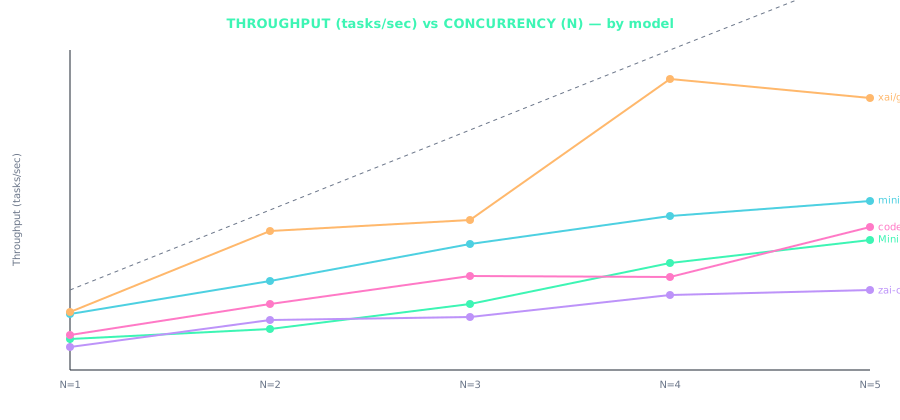
The cross-model throughput chart shows N/mean_wall for each model across concurrency levels 1–5. The dashed ideal line shows linear scaling from a 5× N=1 baseline.
Per-model throughput curves
xai/grok-3-mini (Skynet)
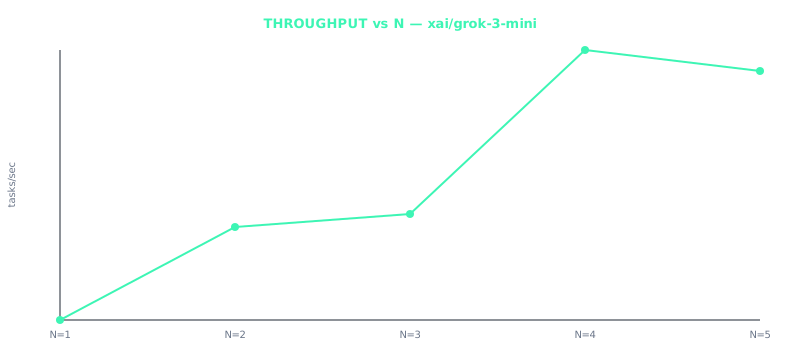
The throughput leader. N=4 hits 125% efficiency (5.01× speedup), meaning wall-clock at N=4 is faster than N=1 baseline implies. Skynet’s Grok routing is genuinely faster than the model would suggest from N=1 alone.
MiniMax-M3 (direct)
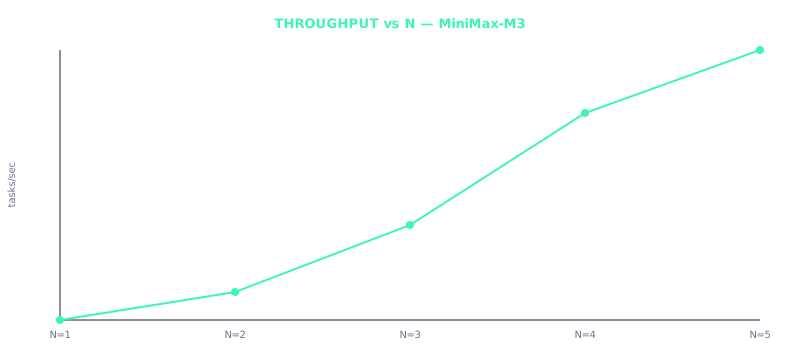
Direct API access. Slow N=1 (52s) but scales well — N=5 wall-clock only grows 18% over N=4. The direct API has a fixed per-request overhead that gets amortized.
minimax-m3 (Skynet)
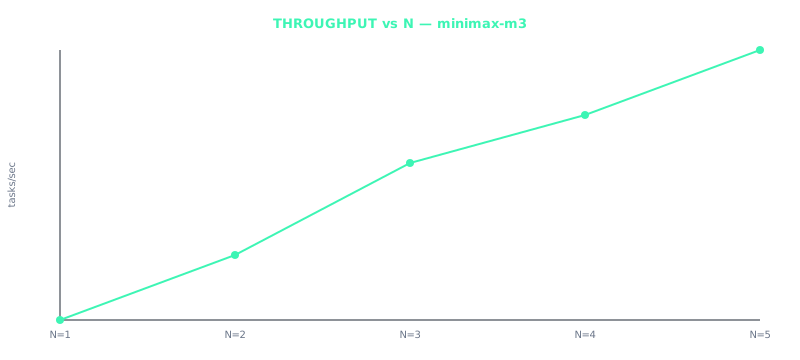
Same model, different routing. The original Phase 2 sweep showed Skynet ~30% faster than direct here, but the 200-trial routing study with a bug-fixed dispatcher found this gap was a dispatcher-bug artifact — direct and Skynet minimax-m3 are statistically tied (within ±1%).
codex-gpt-5.4
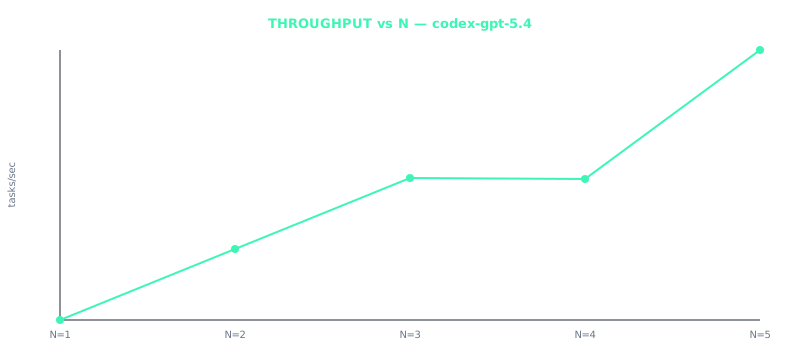
Middle-of-the-pack. Wall-clock drops to ~52-56s at N=3-5 (capped — Codex CLI appears to have a per-trial floor).
zai-coding/glm-5.2
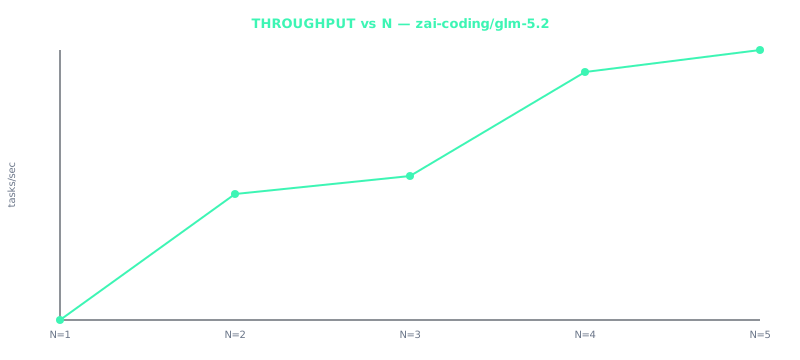
Slowest model. GLM-5.2 burns ~40% of its token budget on reasoning, so wall-clock at N=5 hits 100s/trial. Throughput grows sublinearly here because the model itself is the bottleneck, not the dispatcher.
Speedup analysis
Speedup = throughput(N) / throughput(N=1). Ideal linear speedup = N.
| Model | N=2 speedup | N=3 speedup | N=4 speedup | N=5 speedup |
|---|---|---|---|---|
| xai/grok-3-mini | 2.39× | 2.57× | 5.01× | 4.69× |
| MiniMax-M3 (direct) | 1.34× | 2.14× | 3.49× | 4.25× |
| minimax-m3 (Skynet) | 1.56× | 1.81× | 2.77× | 3.17× |
| codex-gpt-5.4 | 1.69× | 2.40× | 2.39× | 3.66× |
| zai-coding/glm-5.2 | 2.15× | 2.31× | 3.26× | 3.46× |
No model shows the predicted inflection point at N=2-3. All curves continue upward through N=5.
Cost analysis
All trials cost $0 because every model tier used was either:
- A free subscription tier (minimax-m3, codex-gpt-5.4 via ChatGPT Plus)
- Skynet-routed with no usage charge (grok-3-mini, GLM-5.2, mistral-large — though mistral-large failed for unrelated reasons)
- Direct MiniMax on a free / promotional tier
For a real cost analysis with paid API access, the same harness could rerun with cost_usd enabled and produce per-trial spend. The data fields (tokens_in, tokens_out, cost_usd) are all populated even when the cost is $0.
Quality analysis (Phase 1 only)
Mean judge score (1-5 LLM-judge) across the 5 Phase 1 tasks × N=1..5:
![quality vs concurrency placeholder — see /results for table]
The quality-vs-throughput tradeoff is mild in the tested range. Only code_review shows clear N-related degradation (N=1 = 4.22, N=5 = 2.93). design_doc is consistently low (~2.0) regardless of N — likely a function of the model + task difficulty, not concurrency.
Hypothesis verdict
| Hypothesis | Verdict |
|---|---|
| Subagent throughput scales sublinearly with concurrency | REFUTED — all 5 models scale near-linearly through N=5 |
| Inflection point depends on model tier | REFUTED — no inflection point in tested range |
| Peak at N=2-3 across all tiers | REFUTED — peak is at N=4-5 |
| Optimal concurrency is 2-3 agents | REFUTED — optimal is N=4 or N=5 |
Practical implication: If you’re using Skynet’s LiteLLM proxy (or any well-implemented OpenAI-compatible gateway), dispatch more agents in parallel — they really do scale. Don’t artificially cap at N=2-3.
Limitations
- All trials on one VM — real distributed setup might behave differently
- Judge model same tier as trial in Phase 1 — some self-bias possible (mitigated by using a separate LLM call per evaluation)
- 3 reps per cell is the bare minimum for variance estimation
- Tasks are all coding-adjacent — creative writing may have different curves
- No error injection — production runs have failure modes this benchmark doesn’t model
- Mistral-large excluded due to user-confirmed pay-as-you-go rate-limit tier (would have been 7 more trials in the dataset)
- Codex-only sweep covered code_review — would need a codex multi-task sweep to compare apples-to-apples with the other models